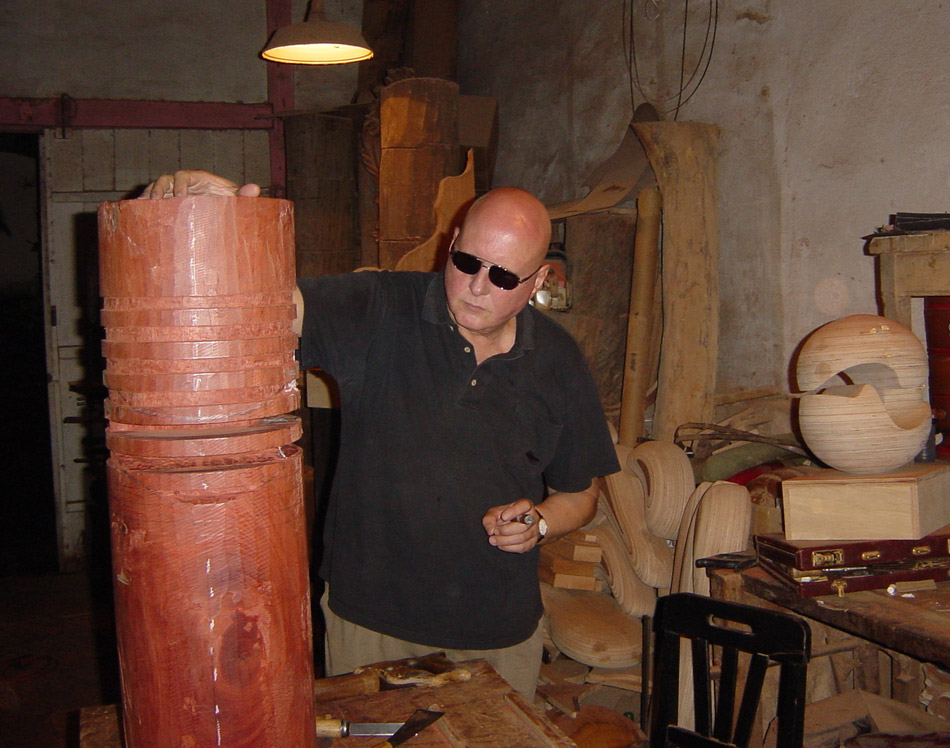
ELIM SATURNINO FERREIRA DUTRA (Bom Jesus, RS).
Escultor. Estudou escultura com Leão Veloso no Instituto de Belas Artes do Rio de Janeiro. Curso de gravura em metal com Rossini Perez.
Vive atualmente em Pirenópolis, Goiás, onde tem o seu atelier e galeria. Possui esculturas em museus e galerias em vários países.
Sculptor. Studied sculpture with Leão Veloso at the Intitute of Fine Arts, in Rio de Janeiro. Metal engraving courses with Rossini Perez.
Currently lives in Pirenópolis, in the state of Goiás, Brazil, where he has his studio and gallery.
His sculptures can be seen at various galleries and museums across the world.
. . .
“Conheço Elim Dutra há cerca de nove anos. Sei do empenho e da seriedade que ele dedica ao fazer escultórico. Nesse espaço de tempo, sua escultura tornou-se mais leve, caminhando para uma síntese só conseguida através da circunstância e do respeito ao material que ele trabalha, sobretudo a madeira. As formas que estão no interior do artista e se transformam em matéria visível tendem, cada vez mais, a relacionar-se com o mundo exterior, produzindo, assim, uma dialética enriquecedora entre o seu universo de formas subjetivas que afloram do inconsciente e a realidade que o cerca. Embora intimistas, as formas significativas de Elim, por suas características especiais, se impõem e buscam integrar-se em ambientes exteriores. A meu ver, deveria ser este o caminho natural da escultura abstrata contemporânea…”.
“I know Elim Dutra for about nine years. I know the pledge and seriousness that he dedicates to his sculptural work. . . Although intimate, the significant forms of Elim, for their spatial characteristics, impose themselves and look for to integration in external ambiences. In my point of view, this should be the natural road of the contemporary abstract sculpture”.
Rubem Valentim,
Painter an Art Critic
Brasília, 1982
. . .
“….As esculturas de Elim Dutra apresentam um feliz equilíbrio entre o material e o significado das formas. As formas fundamentais falam permanentemente a linguagem do escultor e com ele transcendem o desejo e o prazer do entalhe. Convertem o ofício de escultor numa permanente e fascinante oração. O material é a doutrina e a verdade da obra…”
Maria Teresa Guerrero R
Art Critic., Bogotá, 1988
. . .
“…..Há, pelo menos, duas características marcantes na escultura de Elim Dutra: o respeito pelo material e a obsessão pela pureza da forma. Nesse binômio, os integrantes interagem constantemente, e seu trabalho é o resultado desse processo. De fato, a recíproca também é verdadeira, pois Elim respeita igualmente as formas que inventa e nutre idêntica obsessão pela pureza do material…”
José Neistein
Revista “Skultura “, São Paulo
. . .
“…A arte escultórica de Elim Dutra é sóbria, sobretudo em sua primeira fase; é uma escultura limpa que convoca todos os sentidos e convida à carícia. Suas obras são cuidadosas, de formas arredondadas, aéreas, que parecem flutuar no espaço de modo plástico. E preciso flutuar ou girar ao redor destas obras quase abstratas que se aproximam, para afastar-se depois até formas reconhecíveis. As vezes se insinua um colo delicado e carnoso e ao contornar abruptamente para surpreender o rosto, descobrimos linhas apenas esboçadas ou remotas sugestões de algo que ainda não chegamos a definir plenamente. Se a arte é o inesperado, a surpresa, a transgressão, harmoniosa idéia do estabelecido, a ruptura com o cotidiano, a frustração do previsível, a fuga até âmbitos irreconhecíveis, a sugestão, o giro malicioso ou a ambigüidade carregada dos sentidos, Elim conseguiu em suas obras alusivas a exata dimensão artística…”
Carlos Alberto Martinez,
“Un escultor brasilero El Siglo, Bogotá, 25/ 9/1988
. . .
“……Convém insistir noutro aspecto: o cuidado com que o escultor extrai, da epiderme delicada de suas madeiras, sugestivos efeitos fotocromáticos. Elim as acaricia, de sorte que o olho do espectador também acaba colhendo análoga satisfação erótica à flor dos veios”
Armindo Trevisan,
do livro: “Escultores Contemporâneosdo Rio Grande do Sul”, 1983
. . .
“…..A escultura de Elim é tão pura, forte, contida, estilizada e elegante além de sensual…”
José Neistein, Elim Dutra”, New York, 1983
. . .
This is not a traditional hobby among diplomats. Stone cutting is not one of those things that come to your mind after a day of negotiations or a trade agreement preparatory meeting. However Elim Dutra is not a traditional diplomat…” I discovered my passion for sculpture while I was preparing for my diplomatic career. I decided to have both as independent professions. Dutra does not consider sculpture as a hobby. It is an integral part (consummating) profession to which he devotes his time and effort whenever possible.
He exhibits his works in Brazil and abroad, and has his own gallery in Brazil.” I may not be always able to devote enough time for sculpture but I work on weekends and holidays. No one has all the needed time, but I allocate whatever time possible for artistic work”.
Sometimes the Brazilian diplomat is able to allocate time for his work to concentrate on his second profession. Last year for instance, the Brazilian Ministry of External Relations allowed him a holiday to participate in the Aswan International Symposium of Sculpture with a huge work. However, amidst his work, he was suddenly recalled for an urgent mission to whom he could only acquiesce.” I went and returned as soon as possible to complete my sculpture. I had to work every day from 8 am to 8 pm to finish my work. The sculpture, weighing 19 tons, now stands on a hilltop overlooking the Nile in an open-air museum in Aswan.”
Does he think art integrates or contradicts with diplomacy? Dutra replies with an artist’s frankness “Diplomacy, as the saying goes, is an art. It is work based on negotiations and dealing with others. Art is strictly personal. The artistic piece that you create is at your finger tips; it does not need negotiations with others to create it in a certain shape. Moreover, art breeds modesty. Art is our only legacy. Look at Naguib Mahfouz, for instance, he has passed away but his books remain with us. Art is something strong and continuous”.
The works that Dutra makes have a strong dramatic effect in spite of a clearly abstract tendency. Some of them resemble the totems derived from Brazilian heritage, others have human traits, but all enjoy distinct symmetry similar to the symmetry in natural formations as well as that of the human body. The assistants, working with him in Aswan on the huge stone piece, were unable to visualize it except as a human form. They named it ZAIIM (THE LEADER) in spite of its being devoid of human features; it appears strong, commanding, and stable in its opinions and knowing what it wants.
Nabil Shawkat, Cairo, 2007
. . .
Le mal de l’art
Lorsqu’on est mordu d’art et plus spécialement de sculpture, on ne peut que s’y laisser prendre, tout comme l’appel de la sirène dont on ne peut, en aucun cas, se soustraire quitte à perdre sa vie. Ils sont des milliers à travers le monde qui, sans savoir pourquoi, ont consacré leur vie à l’art. Et il y en a d’autres encore plus nombreux, qui n’ont pu s’y consacrer entièrement pour diverses raisons et ne cessent de jongler sur une corde raide pour répondre à leur passion. Est-ce un mal ?
Il suffit de discuter avec S. E.M. Elim Dutra , ambassadeur du Brésil au Caire , pour comprendre que l’art pour lui n’est pas un passe-temps qu’il pratique à ses temps perdus mais qu’il l’habite, le remplit de joie de vivre et de surcroît contamine les personnes qui s’en approchent. Est-ce dû à son pays le Brésil, à la ville d’Assouan où je l’ai rencontré pour la première fois durant le Symposium de Sculpture ou encore et tout sûrement au travail du granit ? Une pierre qui ne ressemble à nulle autre. Celle des rois !
Mais sculpter, dans de différents matériaux, est une envie gloutonne qu’il mène avec frénésie comme s’il n’avait rien d’autre à faire dans la vie. Il le dit lui-même : J’ai toujours eu deux carrières parfaitement séparées. J’ai fait en sorte que les diplomates ne m’appellent pas artiste et que les artistes ne fassent pas le contraire.
D’une simplicité surprenante,- l’art n’est –il pas ce qui dilue les différences et les inégalités ?-, il communique une passion et une spontanéité extraordinaires. Et pourtant son métier est fait de compromis, de retenue et de sang-froid. Toutefois, paradoxalement, c’est à travers la sculpture qu’il comprend mieux le monde des hommes. Avec la sculpture, la vie apparaît comme quelque chose de plus profond, de plus intéressant ; et ceci m’équilibre et me rend sage en tant que diplomate, affirme cet homme qui se consacre à la sculpture le soir, les fins de semaine et durant les vacances. Néanmoins, son énorme sculpture intitulée Le Boss, Chef de Ttribu ou Patron qu’il a réalisé au Symposium d’Assouan en 2006 et qui, malheureusement est trop grande pour figurer lors de cette nouvelle exposition, est une sorte de clin d’œil ironique qui avec distance relie ses deux mondes en se moquant de lui-même et des autres. N’est-ce pas là cette sagesse dont il parle ?
Soheir Fahmi, Cairo, 2007
EXPOSIÇÕES/
(*) INDIVIDUAIS
EXHIBITIONS/
(*) SINGLE SHOWS
1981
– Trigésimo Oitavo Salão Paranaense/ Curitiba, PR
1982
– Primeiro Salão de Arte Latina/ Recife,PE
– Skulture Gallery/ São Paulo, SP
– (*) Elim Dutra FIESP Gallery of Art/ São Paulo, SP
– Aktuel Gallery/ Rio de Janeiro, RJ
– (*) Elim Dutra, National Theater Gallery/ Brasília, DF
1983
– Contemporary Sculpture of RGS/ UFRS, Porto Alegre, RS
– Three Gauchos Sculptors/ Singular Gallery, Porto Alegre, RS
– Aktuel Gallery, Rio de Janeiro/ RJ
– “Christmas Show”, Touchstone Gallery/ Washington, DC
1984
– (*) Elim Dutra –Recent Sculptures /, Touchstone Gallery/ Washington, DC
– Skulpture Gallery/ São Paulo, SP
– Singular Gallery/ Porto Alegre, RS
– Kouros Gallery/ New York, NY
– (*) Elim Dutra –Bronze Sculptures/ ECT Gallery of Art, Brasília, DF
– Expansion: Two and Three Dimensional Large Works/
– Touchstone Gallery, Washington, DC
– The Philips Collection Benefit/ Washington, DC
1985
– Skulture Gallery/ São Paulo, SP
– Brazilian 20th Century Art from Washington Collections/BACI, Art Gallery/ Washington, DC
– (*) Elim Dutra, One Citicorp/ New York, NY
1987
– Bolsa de Arte Gallery/ Porto Alegre,RS
– Skulture Gallery/ São Paulo, SP
1988
– (*) Elim Dutra – Sculptures/ Museum of Contemporary Art, Bogota, CO
1990
– (*) Elim Dutra – Wood Sculptures/ ECT Art Gallery Brasilia, DF
1991
– Performance Gallery/ Brasília, DF
– Visual Gallery/ Brasilia, DF
1992
– Marisa Soyberman Gallery/ Porto Alegre, RS
– Bolsa de Arte Gallery/ Porto Alegre, RS
1993
– Kunst in Zurichhaus/ Hamburg, FRG
– (*) Das Haidhausen Museum/ Munich, FRG
1994
– (*) Elim Dutra/ BMW Gallery, Bonn, FRG
1997
– (*) Elim Dutra – Recent Sculptures/Hanover International Fair, FRG
– (*) Elim Dutra – Sculptures/Museum of Contemporary Art of RGS, Porto Alegre, RS
2001
– Meeting ArgentinaBrasil/Museum of Contemporary Art of Latin America, La Plata, Buenos Aires
2003
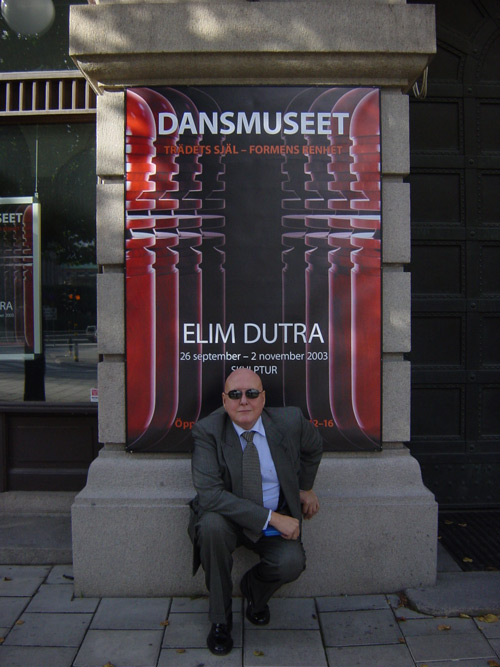
– (*) Elim Dutra –tradets sjal –formens renhet/Dansmuseet, Stockholm, SE
2007
– (*) Elim Dutra/Zamalek Art Gallery, Cairo, Egypt
 ELIM DUTRA
